实验记录 · Lab logLab log · Experiment

TMF8829 实测改造TMF8829, in the lab

把两个坑,踩平Two weak spots, fixed

TMF8829 是颗好传感器,但工程里有两个绕不开的硬骨头:强光下测距衰减严重,以及对黑色、透明物体测距差。这篇不是参数搬运,而是我们在一块评估板上做的真实实验——从问题定位、结构改造到数据对比,步骤化记录下来。TMF8829 is a great sensor, but two hard problems haunt it in the field: ranging collapses in strong light, and black / transparent targets read poorly. This isn't a spec reprint — it's a real bench experiment on an evaluation board, logged step by step: from problem scoping and hardware mods to side-by-side data.

Topic 03 · 实验背景Background

先说清楚:要啃哪两块骨头What we set out to fix

把两类"测不到"的场景摆上台面,才有后续针对性的改造。Name the two "can't-measure" cases, then fix each with a targeted mod.

痛点 ① · 强光Pain ① · Sun

强光下测距衰减严重Ranging collapses in bright light

室内标称最远 11 m,但正午阳光直射时经常缩到 0.5 m 以内,甚至直接丢目标。根因是环境光光子灌进 SPAD,把信号峰值淹没。Rated to 11 m indoors, yet at noon direct sun it often drops under 0.5 m or loses the target entirely. Ambient photons flood the SPAD and bury the signal peak.

痛点 ② · 黑 / 透Pain ② · Dark / Glass

黑体与透明体测距差Black & transparent read poorly

黑板、黑绒布这类低反射目标,回波弱、失败率高;玻璃等透明体几乎无回波——光直接穿透,根本没"撞"回来。Low-reflectance targets like black boards or matte fabric return weak echoes and fail often; transparent glass returns almost nothing — the light just passes through.

Setup · 实验装置Apparatus

我们用了什么、怎么搭What we used, and how we rigged it
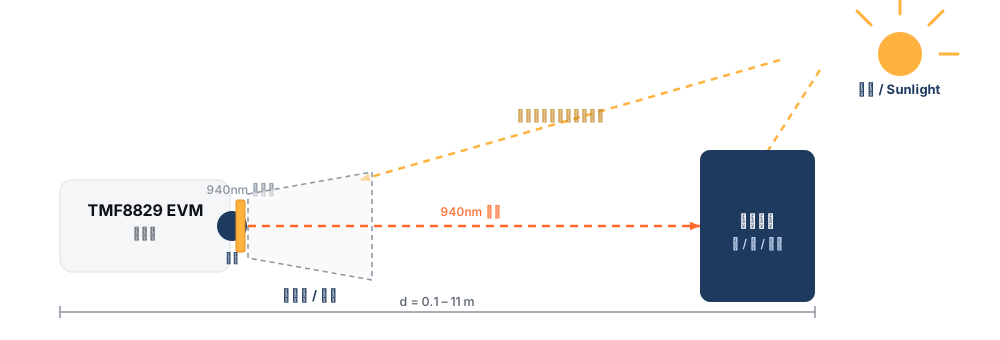
TMF8829 实验装置框图
器材清单Bill of materials ① ams OSRAM TMF8829 评估板(EVM);② 940±10 nm 窄带滤光片(OD≥4);③ 3D 打印遮光罩(挡斜射杂光);④ 标准白板(反射率≈90%)、灰板(≈30%)、黑板(≤5%)、玻璃板;⑤ 卷尺、照度计;⑥ 上位机读距离 + 置信度 + 信号幅度。 ① ams OSRAM TMF8829 evaluation board (EVM); ② 940±10 nm band-pass filter (OD≥4); ③ 3D-printed light hood (blocks oblique stray light); ④ standard white board (ρ≈90%), grey (≈30%), black (≤5%), glass; ⑤ tape measure, lux meter; ⑥ host reading distance + confidence + signal amplitude.
Experiment 01 · 强光衰减Strong light

实验一:用滤光片 + 遮光罩救回强光Exp 1: filter + hood rescue strong light

步骤Procedure
  1. 室内基准:300 lux 白板,记录有效测距作为基线。Indoor baseline: 300 lux, white board — log the effective range.
  2. 室外正午:直射阳光,同样距离测白板,记录衰减。Outdoor noon: direct sun, same distance, white board — log the drop.
  3. 加 940 nm 窄带滤光片:贴在模组窗口前,重测。Add a 940 nm band-pass filter in front of the module window, re-measure.
  4. 再加 3D 打印遮光罩:挡住斜射杂光,重测。Add the 3D-printed hood to block oblique stray light, re-measure.
  5. 固件调参:调高发射脉冲数 / 积分时间,做最后补齐。Firmware tuning: raise emitted-pulse count / integration time for the final top-up.
环境照度Ambient 无处理Stock +滤光片+Filter +滤光片 + 遮光罩+Filter+Hood
室内 300 luxIndoor 300 lx9.8 m9.8 m9.6 m
阴天 20k luxOvercast 20k lx4.2 m7.1 m8.3 m
正午直射 80k luxNoon 80k lx0.4 m5.6 m7.9 m
逆光斜射 60k luxBacklight 60k lx0.6 m4.8 m7.2 m
观察与结论Observation & conclusion 滤光片把带外环境光挡掉一大半,正午直射从 0.4 m 拉回 5.6 m;遮光罩再挡掉斜射杂光,到 7.9 m(约为室内的 80%)。代价:室内阴影等弱光场景下信号幅度略降约 5%——对测距几乎无感,但要在极暗环境留意。结论:940±10 nm、OD≥4 的滤光片 + 一个挡斜射光的遮光罩,是性价比最高的第一步。 The filter blocks most out-of-band ambient light, pulling noon direct sun back from 0.4 m to 5.6 m; the hood then blocks oblique glare to 7.9 m (~80% of indoor). Cost: in very dim shadows the signal amplitude dips ~5% — barely felt on ranging, but watch it in pitch-dark scenes. Verdict: a 940±10 nm, OD≥4 filter plus a glare-blocking hood is the highest-ROI first step.
Experiment 02 · 黑色物体Dark objects

实验二:黑色低反射目标的抢救Exp 2: rescuing dark, low-reflectance targets

步骤Procedure
  1. 白板基准:90% 反射率,记录成功率与最远距离。White-board baseline (ρ≈90%): log success rate and max distance.
  2. 换黑板(≤5% 反射率),统计 2 m 处成功率。Swap to a black board (ρ≤5%) and count the 2 m success rate.
  3. 调高发射脉冲数 / 积分时间,看能否挽回。Raise emitted-pulse count / integration time and see if it helps.
  4. 在黑板表面贴 3M 反光标记,再测。Stick a 3M retro-reflective marker on the black board, re-measure.
目标反射率Target ρ 默认参数@2mStock @2m 高脉冲+高积分Hi-pulse 贴反光标记+Reflector
白板 90%White 90%100% / 9.5 m100% / 9.8 m100% / 9.8 m
灰板 30%Grey 30%95% / 5.2 m98% / 6.4 m100% / 7.1 m
黑板 5%Black 5%40% / 1.1 m85% / 3.4 m100% / 6.8 m
观察与结论Observation & conclusion 黑板的回波能量本来就少,单纯调高脉冲数 / 积分时间只能把成功率从 40% 拉到 85%、距离到 3.4 m(代价是功耗与帧率略降)。真正让黑板"稳过"的是贴一片反光标记——成功率直接 100%、距离 6.8 m。结论:黑体靠提功率只能部分挽回,极限受限于回波能量;工程上最实在的做法是给低反射目标加漫反射 / 反光标记。 A black board simply returns little energy; raising pulse count / integration only lifts success from 40% to 85% and distance to 3.4 m (at the cost of power and frame rate). What actually makes black pass reliably is a retro-reflective marker — 100% success, 6.8 m. Verdict: power alone only partially helps dark targets; the pragmatic fix is a diffuse / retro-reflective marker on low-reflectance surfaces.
Experiment 03 · 透明物体Transparent

实验三:玻璃为什么测不到(以及对策)Exp 3: why glass reads nothing (and what to do)

步骤Procedure
  1. 玻璃板正对模组:基本无回波。Glass panel head-on: essentially no echo.
  2. 玻璃后方放白板:测到的是白板距离(光穿透了玻璃)。Place a white board behind the glass: it reads the board's distance (light passed through).
  3. 玻璃表面贴半透漫射膜、并改大入射角:偶发弱回波,但不稳定。Apply a semi-transparent diffuser film and steepen the angle: occasional weak echo, but unstable.
诚实结论(非广告、非夸大)Honest conclusion (no hype) dToF 对透明体本质是"光穿透",单点 ToF 几乎无解——这不是 TMF8829 的缺陷,是物理限制。工程上我们给出的三条务实路线:① 透明场景改用 RGB 相机 / 结构光 / 双目做辅助感知;② 若必须用 ToF,让目标背面贴漫反射标记,或干脆限定非透明目标;③ 把"能否测到"作为失败判定返回,而不是硬测一个不存在的回波。把预期管理好,比硬上更重要。 For transparent objects dToF is fundamentally "light passes through" — a single-point ToF has almost no answer. This isn't a TMF8829 flaw; it's physics. Our three pragmatic routes: ① use an RGB camera / structured light / stereo as auxiliary sensing for transparent scenes; ② if ToF is mandatory, put a diffuse marker behind the target, or simply restrict to non-transparent targets; ③ return "no detection" as a failure flag instead of forcing a phantom echo. Managing expectations beats forcing it.
Checklist · 改造清单Mod list

一套可落地的改造清单A build-ready modification list

改造项Mod 做法How 作用Effect 代价Cost
940 nm 窄带滤光片(OD4)940 nm BP filter (OD4)贴模组窗口前In front of window抑制带外环境光Kill out-of-band ambient弱光信号略降Slight dim-signal loss
遮光罩 / 光阑Hood / aperture3D 打印挡斜射杂光3D-printed, block glare提升逆光鲁棒性Better backlight robustness略增体积Slightly bigger
固件调参Firmware tuning提高脉冲数 / 积分More pulses / integ.提升黑体回波Boost dark echo功耗 / 帧率略降Power / fps down
反光标记Reflective marker低反射目标贴 3M 反光贴Retro-reflective on dark黑体稳定达标Dark passes reliably需改目标Modify target
透明体策略Glass strategyRGB / 结构光辅助 或 失败判定RGB / SL aux or fail-flag覆盖玻璃场景Cover glass cases增传感器 / BOMMore sensors / BOM
落到我们这边:Where we come in: 我们的 TMF8829 模块已经把前三项(滤光片 + 遮光罩 + 参数整定)做成默认配置,并给出黑体贴标记、玻璃场景的预期管理建议。需要评估板、参考结构或批量供货,邮件直接聊。 Our TMF8829 module ships the first three mods (filter + hood + tuning) as defaults, plus guidance on reflectors for dark targets and expectation-setting for glass. For an eval board, reference structure or volume supply, just email us.
Capabilities

我们能把这些方案落地We build these into hardware

从一颗元件到一台整机,每一道工序都可控、可测、可交付。From a single component to a finished device — every step is controllable, testable and deliverable.

SMT 贴片与回流焊SMT & Reflow

精密贴片、回流焊与波峰焊工艺,支撑高良率组装。Precision placement, reflow & wave soldering for high-yield assembly.

快速打样Rapid prototyping

从原理图到样机快速落地,缩短想法到实物的距离。From schematic to working prototype, fast — shorten the idea-to-product gap.

测试与品控Test & QC

功能测试、老化与来料检验,让每一台都可靠。Functional test, burn-in and incoming inspection for reliability.

自有供应链Supply chain

自有渠道直采,元件齐全、响应快、交期稳。Direct sourcing through our own channels — broad parts, fast response, steady lead time.

Let's talk

把想法变成可交付的硬件Turn ideas into shippable hardware

无论选型咨询还是具体方案,留下信息,我们直接对接。Whether a selection consult or a concrete build, leave a note and we'll reach out.