USB 从 5 Gbps ���到 10 Gbps,再到 DP2.1 UHBR13.5,插到连接器和线缆上的那一段永远是链路里最脆弱的地方。Redriver 就是补这一段的——它接收衰减信号、按可配置的均衡量线性放大再重发。本篇讲清它在信号链里的位置、Realtek 的 3-in-1 集成路线、与 TI / Parade / Diodes 的横向对比、各场景怎么选,以及 redriver 和 retimer 的边界在哪。As USB moves from 5 Gbps to 10 Gbps and on to DP2.1 UHBR13.5, the stretch of trace, connector and cable is always the weakest link. A redriver recovers that stretch: it receives the attenuated signal, applies configurable linear equalization, and retransmits. This piece covers where it sits in the chain, Realtek's 3-in-1 integration, how it compares to TI / Parade / Diodes, how to choose per scenario, and where a redriver stops being the right answer.
PCB 走线是线性衰减介质,连接器和线缆继续叠加损耗。Redriver 接收已衰减的信号,做线性放大与均衡后重发——效果约等于"移除或缩短那段走线",让总通道损耗落回 USB-IF 预算之内。PCB trace attenuates linearly, and connectors and cables add more loss. A redriver receives the attenuated signal, applies linear gain and equalization, and retransmits — effectively "removing or shortening" that stretch of trace so total channel loss falls back inside the USB-IF budget.
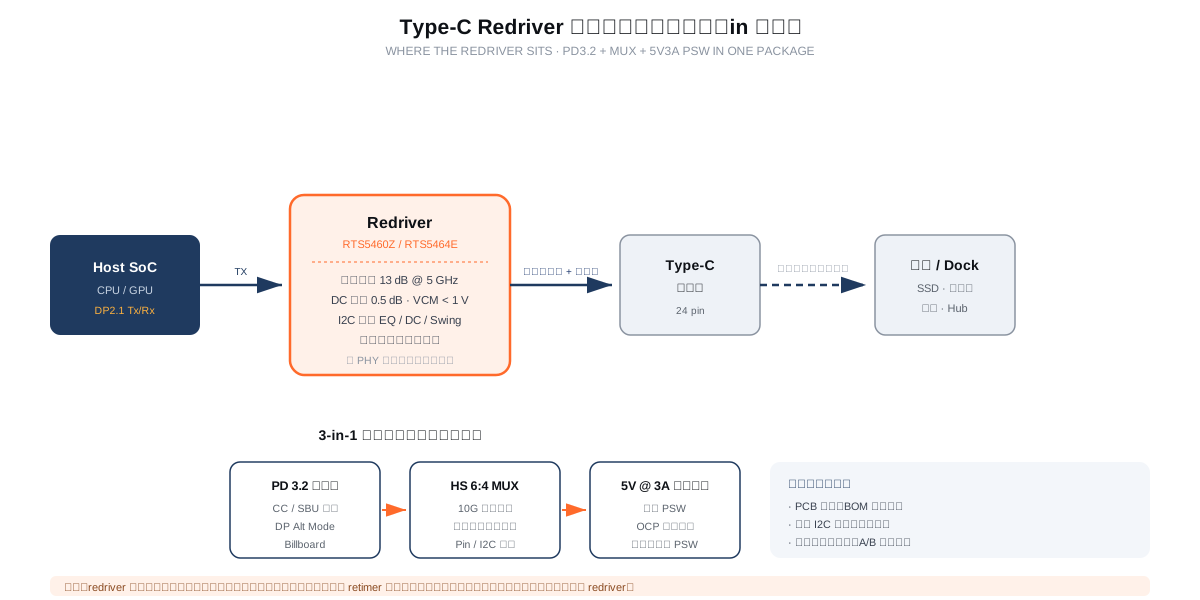
Type-C 端口的复杂度集中在三件事:PD 协商、高速极性切换、供电。Realtek 的做法是把它们和 redriver 做进同一颗芯片。A Type-C port's complexity boils down to three things: PD negotiation, high-speed polarity switching, and power. Realtek folds all three together with the redriver in a single part.
线性均衡 13 dB @ 5 GHz,PD3.2 + USB3.2 Gen2x1 redriver,内置 6:4 10G MUX,I2C 配置 EQ / DC gain / Swing,自动省电管理,支持 DP2.1 UHBR13.5,极低功耗(µA 级),内置 3.3V→1.0V LDO。QFN60,5×9 mm。Linear equalization 13 dB at 5 GHz; PD3.2 + USB3.2 Gen2x1 redriver with a built-in 6:4 10G MUX; I2C configuration of EQ, DC gain and swing; automatic power saving; DP2.1 UHBR13.5 support; extreme low power (µA-class) with an integrated 3.3 V→1.0 V LDO. QFN60, 5×9 mm.
集成 LDO 意味着接收端可直接用 1.0 V 供电,省掉一路电源设计与噪声 concerns。The integrated LDO lets the receiver run directly from 1.0 V, removing a supply rail and its noise concerns.
在2-in-1 基础上再集成 5V@3A 电源开关,兼容性与散热更好,QFN40 4×6 mm。一颗顶掉「redriver + HS MUX + PD 控制器 + 电源开关」四颗料,PCB 面积与 BOM 同步下降,I2C 走线与调试节点大幅减少。Adds an integrated 5 V @ 3 A power switch on top of the 2-in-1, with better compatibility and thermal behaviour, in QFN40 4×6 mm. One part replaces "redriver + HS MUX + PD controller + power switch" — board area and BOM drop together, and I2C routing and debug nodes shrink sharply.
RTS5460Z 为 PD3.2 + Gen2 redriver + 5V3A PSW,QFN60 5×9;RTS5461C 走 1 port Type-C、RTS5467M 走 2 port Type-A,均支持 pin mode 与 DP2.1 UHBR13.5,QFN34 2.5×4.5 mm,功耗 20 µA(关断)。共同规格:AC gain 13 dB、DC gain 0.5 dB、VCM < 1 V。覆盖 NB/Docking/Monitor 各类形态。RTS5460Z is PD3.2 + Gen2 redriver + 5 V 3 A PSW in QFN60 5×9; RTS5461C targets 1-port Type-C and RTS5467M 2-port Type-A, both with pin mode and DP2.1 UHBR13.5, QFN34 2.5×4.5 mm, 20 µA shutdown. Common specs: 13 dB AC gain, 0.5 dB DC gain, VCM < 1 V. Covers notebook, docking and monitor form factors.
面向 PC 市场向 5 nm/3nm 演进、SoC I/O 降到 1.2 V 的趋势,同时要兼容 3.3 V 传统 USB 器件。eUSB2 在物理层做了电压模式改造:HS 用 200 mV 电压模式(USB2 是 400 mV 电流模式),LS/FS 用 1.0/1.2 V(USB2 是 3.3 V),优势是更低功耗。共同特性:支持 HS/FS/LS、repeater 架构、LPM-L1(L1) 与 Suspend(L2) 链路电源管理、RAP 寄存器访问协议、自动resume 与远程唤醒。RTS5435 进一步把 PD3.2 与 eUSB2 repeater 集成(SPR 20V OVP / EPR 28V OVP,4 个 DFP 可配置 eUSB2/USB2)。Built for the PC market's move to 5 nm/3 nm where SoC I/O drops to 1.2 V, while legacy USB devices still run at 3.3 V. eUSB2 changes the physical layer: HS in 200 mV voltage mode (vs 400 mV current mode in USB2), LS/FS at 1.0/1.2 V (vs 3.3 V) — the benefit is lower power. Common features: HS/FS/LS support, repeater architecture, LPM-L1 (L1) and Suspend (L2) link power management, RAP register access, auto resume and remote wakeup. RTS5435 goes further, integrating PD3.2 with the eUSB2 repeater (SPR 20 V OVP / EPR 28 V OVP, four DFPs configurable between eUSB2 and USB2).
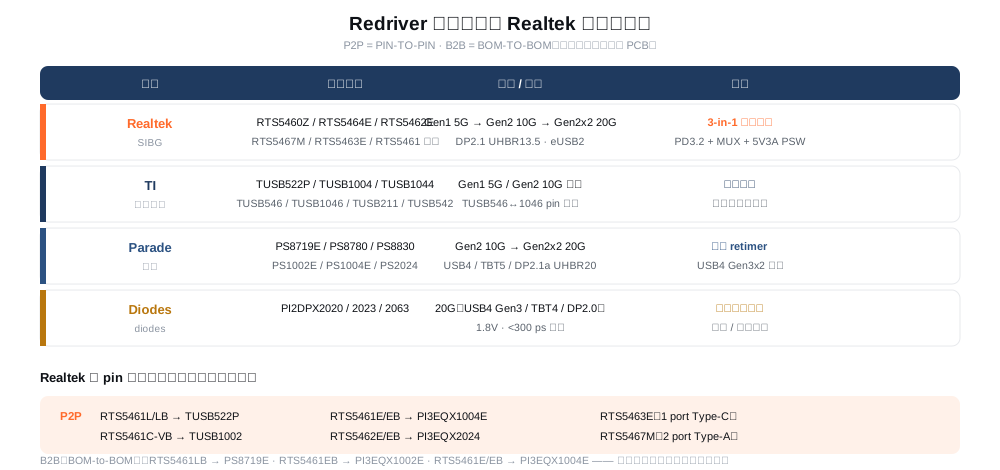
下表是 redriver / retimer 市场的四个主要玩家。选型时最该看的是"换料要不要改板"——这决定了你换供应商时的隐性成本。Four main players in redriver / retimer. The question that matters most in selection is whether changing parts forces a board respin — that decides the hidden cost of switching suppliers.
| 维度Dimension | RealtekRealtek | TITI | Parade(谱瑞)Parade | DiodesDiodes |
|---|---|---|---|---|
| 产品线覆盖Portfolio | Gen1 5G / Gen2 10G / Gen2x2 20G 全覆盖,另有 eUSB2 repeater 线Full Gen1 5G / Gen2 10G / Gen2x2 20G coverage, plus an eUSB2 repeater line | 以 Gen1 / Gen2 为主,USB4 侧另有 retimerMostly Gen1 / Gen2; separate retimers for USB4 | Gen2 10G / Gen2x2 20G,retimer 覆盖 USB4 Gen3x2Gen2 10G / Gen2x2 20G, with retimers for USB4 Gen3x2 | 主打 20 Gbps DP2.0 / TBT4 / USB4 Gen3Focus on 20 Gbps DP2.0 / TBT4 / USB4 Gen3 |
| 集成度Integration | 最高Highest:PD3.2 + MUX + 5V3A PSW + redriver 3-in-1,部分含 LDO | redriver 多为独立,PD 控制器另配Mostly discrete redrivers, PD controller as a separate part | redriver / retimer 为主,集成度中等Focused on redriver/retimer, moderate integration | 纯 redriver,极致低功耗小封装Pure redriver, very low power and small package |
| EQ 能力EQ capability | 线性均衡 13 dB @ 5 GHz,DC gain 0.5 dB,VCM < 1 VLinear EQ 13 dB @ 5 GHz, DC gain 0.5 dB, VCM < 1 V | TUSB1046 最高约 11 dB EQ @ 10G USB、14 dB @ DP1.4;TUSB522 多档 3/6/9 dBTUSB1046 up to ~11 dB EQ @ 10G USB, 14 dB @ DP1.4; TUSB522 3/6/9 dB steps | 可调 EQ / 平坦增益,参数接口灵活Adjustable EQ / flat gain with flexible parameter interface | 引脚或 I2C 配置 EQ 与增益,延迟 < 300 psPin or I2C configurable EQ/gain, < 300 ps latency |
| Pin 兼容Pin compatibility | 提供 P2P / B2B 对标Offers P2P / B2B cross-references:RTS5461C-VB ↔ TUSB1002、RTS5461E/EB ↔ PI3EQX1004E、RTS5462E/EB ↔ PI3EQX2024、RTS5461L/LB ↔ TUSB522P;B2B 还有 PS8719E、PI3EQX1002E | TUSB546 与 TUSB1046 互 pin 兼容,便于 Gen1→Gen2 平滑升级TUSB546 and TUSB1046 are pin-compatible for smooth Gen1→Gen2 upgrades | PS8780 与上代 PS8778 引脚 100% 兼容,可直接贴片替换PS8780 is 100% pin-compatible with PS8778 for drop-in replacement | 同系列 2020/2023/2063 多通道共用设计2020 / 2023 / 2063 share a common design across channels |
| 平台认证Platform qualification | Intel PCL 认证Intel PCL qualified:RTS5453P(-VB/-28)/RTS5452P(-VB/-28) 是 Lunar Lake / Arrow Lake / Panther Lake / Wildcat Lake 的 iPOR;Nova Lake iPOR 为 CFP2.0 RTS5453P-20E;RTS5453 获 Intel TBT Certification PCL | 份额最大,生态与文档最全Largest share, most complete ecosystem and documentation | USB4 / TBT5 方向布局早Early positioning in USB4 / TBT5 | 笔电 / 平板等移动端认可度较高Strong acceptance in notebooks and tablets |
| 功耗与封装Power & package | 关断 20 µA;µA 级极低功耗型号;QFN24/34/40/60、eUSB2 到 WLCSP1220 µA shutdown; µA-class ultra-low-power parts; QFN24/34/40/60, eUSB2 down to WLCSP12 | TUSB522P 活动 98 mA / 关断 60 µATUSB522P: 98 mA active, 60 µA shutdown | 多通道集成,功耗与通道数相关Multi-channel integration, power scales with channels | 最省电Lowest power:1.8 V 供电,W-LGA4528 2.85×4.5×0.7 mm |
| 适合的形态Best fit | NB / Dock / Monitor / MB / IPC / Console / Desktop,Intel 平台生态Notebook / dock / monitor / MB / IPC / console / desktop, Intel platform ecosystem | NB / MB / Console / Monitor,通用服务器与消费类Notebook / MB / console / monitor, general server and consumer | 高端工作站、AI 笔电、8K 显示器、40G 扩展坞High-end workstations, AI notebooks, 8K monitors, 40G docks | 笔电、平板、主机、显示器、主动线缆Notebooks, tablets, desktops, monitors, active cables |
(表内规格为量级参考,具体 EQ 曲线、抖动、功耗与温度范围以厂商最新 datasheet 为准。)(Figures are order-of-magnitude guidance; exact EQ curves, jitter, power and temperature range per the latest vendor datasheet.)
同样是 Type-C 端口,笔记本、扩展坞、显示器、主动线缆的通道条件完全不同,选型自然不同。A Type-C port in a notebook, a dock, a monitor and an active cable face very different channel conditions — so the selection differs accordingly.
| 场景Scenario | 通道特征Channel | 推荐方向Recommendation | 注意Watch out |
|---|---|---|---|
| 笔记本Notebook 内置USB-CBuilt-in USB-C |
SoC 到连接器主板长走线,20 Gbps Gen2x2 或 DP2.1;空间与功耗都紧Long PCB run from SoC to connector at 20 Gbps Gen2x2 or DP2.1; tight for area and power | 优先低功耗 + 集成度高的 3-in-1:RTS5464E / RTS5460Z 之类,一颗顶三颗,BOM 与面积双降。走Intel 平台应确认 PCL 认证名单(iPOR 型号)优先。F favour low power + high integration 3-in-1 parts such as RTS5464E or RTS5460Z — one part replaces three, cutting both BOM and area. On Intel platforms check the PCL (iPOR) list first. | 别为省成本去掉 redriver 然后在售后靠"少用扩展坞"来掩盖眼图问题;正反插两条路径要分别验证。Don't drop the redriver to save cost and then mask eye-diagram issues with "avoid docks"; verify both A and B orientations separately. |
| 扩展坞Dock 多口密集Many ports |
上游口到每个下行口分支走线长;多红器共存;需同时供电下游Long split traces from upstream to each downstream; multiple lanes; must also power downstream | 主机侧口用集成 PSW 的 3-in-1(省掉独立电源开关与一路 I2C);下行口按需用 Gen1 redriver 即可。端口多时 MUX 也要算进去,用带 6:4 MUX 的型号可省一颗。Use a 3-in-1 with PSW for the host port (removes a discrete power switch and an I2C bus); Gen1 redrivers usually suffice for downstream ports. With many ports, factor in the MUX too — a part with an integrated 6:4 MUX saves another chip. | 供电与信号共地噪声要一起验证;热插拔(hot-plug)场景确认 LFPS / de-emphasis 联动是否自动。Validate power and signal return paths together; for hot-plug confirm whether LFPS / de-emphasis interaction is handled automatically. |
| 显示器Monitor DP Alt ModeDP Alt Mode |
DP 视频从 GPU 出来,Alt Mode 切换带来额外损耗与更长的协议处理器走线DP video from the GPU, with extra loss from Alt Mode switching and longer routing to the protocol chip | 需要同时处理 USB 与 DP 两套 EQ 曲线的 redriver(USB 与 DP 的均衡曲线不同);带 AUX MUX 与 PD Alt Mode 支持的型号优先。分辨率越高(4K/8K)越不能省。Pick a redriver that handles both USB and DP EQ curves (they differ), and prefer parts with AUX MUX and DP Alt Mode support. The higher the resolution (4K/8K), the less you can economise here. | DP 是单向的,但 redriver 仍需按方向摆放;别指望一颗双向料省事,方向搞反会有明显抖动。DP is unidirectional but the redriver must still be oriented correctly; a bidirectional part won't save you here, and wrong orientation shows up as jitter. |
| 主动线缆Active cable | 长距离传输,两端都要补偿;1 m 以上无源线缆接近极限Long haul with compensation at both ends; passive cables approach their limit past 1 m | 在线缆内部两端各放一颗 redriver(源端与宿端方向相反)。Gen2 及以上考虑支持 DP2.1 UHBR13.5 的型号;若超过 2 m 或需要完整信号重构,应当用 retimer 而不是 redriver。Place one redriver at each end of the cable (opposite directions for source and sink). For Gen2 and above pick a part with DP2.1 UHBR13.5 support; beyond 2 m or where full signal reconstruction is needed, use a retimer, not a redriver. | 线缆内供电空间与散热受限,注意封装尺寸与自身发热;两端 EQ 要配对设置。Space and thermal budget inside a cable are tight — check package size and self-heating; EQ settings on the two ends must be paired. |
| PC 市场前瞻Next-gen PC eUSB2 迁移eUSB2 migration |
SoC I/O 已降到 1.2 V 甚至更低,但要兼容 3.3 V 传统 USB 器件SoC I/O down to 1.2 V or lower, yet must coexist with 3.3 V legacy USB parts | eUSB2 repeater 是过渡期的正解:HS 改用 200 mV 电压模式、LS/FS 用 1.0/1.2 V,功耗更低。Realtek 提供 1 port / 2 port、单端口 PD3.2 集成(1 UFP + 4 DFP)、SPR 20V 与 EPR 28V OVP 多个型号,QFN 与 BGA97 齐备。eUSB2 repeaters are the transition path: HS in 200 mV voltage mode and LS/FS at 1.0/1.2 V give lower power. Realtek offers 1-port and 2-port parts, single-port PD3.2 integration (1 UFP + 4 DFPs), and both SPR 20 V and EPR 28 V OVP, in QFN and BGA97 packages. | eUSB2 的 RAP 寄存器配置与普通 USB 器件不同,主机侧固件要同步支持;查 Intel PCL 是否已列入。eUSB2 uses RAP register access rather than the usual path, so host firmware must support it; verify it appears on the Intel PCL. |
下面几个场景来自我们接触到的真实需求与行业公开案例的共性模式,来说明 redriver 在什么情况下真正救了场。The patterns below come from the real requirements we encounter plus publicly documented cases — showing when a redriver genuinely saves the day.
做 Intel 平台的笔记本与主板,PD 控制器的选择往往不是技术问题而是认证问题。Realtek 的 RTS5453P / RTS5453P-VB / RTS5453P-28 / RTS5452P 系列是 Lunar Lake、Arrow Lake、Panther Lake、Wildcat Lake 的 iPOR,Nova Lake 的 iPOR 是 CFP2.0 的 RTS5453P-20E,RTS5453 另获 Intel TBT Certification PCL。Intel 也允许组合方案:例如 CFP PD + CFP eUSB2 repeater,或 RTS5453P-VB 搭配 RTS5430SQ。对接Intel 平台的新项目,第一步应该是先确认 PCL 名单与 iPOR 关系,而不是先挑性能最强的料。For notebooks and motherboards on Intel platforms, the PD controller choice is often a qualification question rather than a technical one. Realtek's RTS5453P / RTS5453P-VB / RTS5453P-28 / RTS5452P families are iPOR for Lunar Lake, Arrow Lake, Panther Lake and Wildcat Lake; Nova Lake's iPOR is CFP2.0 RTS5453P-20E; RTS5453 also holds Intel TBT Certification PCL. Intel permits combined solutions too — for example CFP PD + CFP eUSB2 repeater, or RTS5453P-VB paired with RTS5430SQ. For a new Intel platform project, confirm the PCL list and iPOR relationships first rather than picking the highest-performance part.
量产后最痛的不是设计,而是料断了还不能改板。Realtek 提供了成体系的 P2P / B2B 对标关系:RTS5461L/LB 对 TUSB522P、RTS5461C-VB 对 TUSB1002、RTS5461E/EB 对 PI3EQX1004E、RTS5462E/EB 对 PI3EQX2024;B2B 层面还有 RTS5461LB 对 PS8719E、RTS5461EB 对 PI3EQX1002E。这意味着一旦 TI 或 Parade 供货出问题,可以在不改 PCB、不重认证的前提下切料——对已经过认证、正在量产的平台,这往往是唯一可接受的动作。The hardest problem after mass production isn't design — it's running out of parts without being able to respin. Realtek provides a systematic set of P2P / B2B cross-references: RTS5461L/LB to TUSB522P, RTS5461C-VB to TUSB1002, RTS5461E/EB to PI3EQX1004E, RTS5462E/EB to PI3EQX2024; at the B2B level, RTS5461LB to PS8719E and RTS5461EB to PI3EQX1002E. If TI or Parade has a supply issue, you can switch parts without changing the PCB or re-qualifying — often the only acceptable action on a certified, shipping platform.
"1.5 米线正常、2 米以上偶发掉帧,DP 偶尔闪一下、USB 音频偶尔爆音"——这类问题的排查路径常常是换协议芯片、换连接器、换电源芯片,最后发现盲区在物理层:把 retimer 应用场景当redriver 来选,选型判断从一开始就错了。判据是三个阈值交叉验证:距离(Gen3x4 走线超 15 cm 或线缆超 1 m 开始影响眼图;超 2 m 单纯 redriver 很难把 BER 压到可接受;超 3 m 没有 retimer 重构基本是赌概率)、带宽余量(多协议并发时有效带宽利用率超 70%,余量低于 30% redriver 还能凑合,低于 20% 必须 retimer)、线缆质量(同一家用同一颗协议芯片,有客户线缆阻抗一致性 ±5% 正常,换成 ±15% 就出问题)。"Works on 1.5 m cables, but above 2 m we get intermittent frame drops, the DP display flickers occasionally, USB audio pops once in a while." The usual path is swapping protocol chips, connectors and power chips, and finally finding the blind spot in the physical layer: treating a retimer application as if it were a redriver, so selection was wrong from the start. The judgement uses three thresholds crossed: distance (Gen3x4 traces beyond 15 cm or cables beyond 1 m start affecting the eye; past 2 m a plain redriver struggles to hold BER; past 3 m without a retimer you're gambling), bandwidth headroom (above 70% utilization with concurrent protocols, headroom below 30% still works with a redriver, below 20% demands a retimer), and cable quality (same protocol chip, one customer's cables at ±5% impedance work fine, another at ±15% fails).
| 细节Detail | 为什么重要Why it matters | 怎么处理How to handle |
|---|---|---|
| EQ 不宜过冲Don't over-equalize | 线性 redriver 允许一定程度的过冲 EQ——它实际表现为在线性范围内的预加重摆幅,用于在长短通道间做优化;但超过线性范围就会变成不可纠正的抖动。A linear redriver tolerates some over-EQ — it effectively becomes a pre-emphasized swing within the linear range, letting you optimise between long and short channels. Push past the linear range and it becomes uncorrectable jitter. | 长短通道分别标定:短通道降EQ 或用 pin mode 固定一档,长通道按需提升。把 EQ 配置写进量产测试项,而不是留在实验室默认值。Calibrate long and short channels separately: reduce EQ (or fix a pin-mode step) on short traces and raise it as needed on long ones. Make EQ configuration part of the production test items, not a lab default. |
| 正反插对称性A/B symmetry | Type-C 可翻转,A/B 两条走线路径长度与拓扑往往不同。带 6:4 MUX 的型号能显著改善这个问题,但不能假设完全对称,仍要分别验证。Type-C is reversible and the A/B paths often differ in length and topology. Parts with a 6:4 MUX improve this significantly, but don't assume perfect symmetry — verify each path. | MUX 选带 AUX MUX 的版本可一并解决 DP Alt Mode 的辅助通道;A/B 两个方向的眼图与误码率都要留数据,定义可接受的 delta 门限。Pick a MUX with AUX MUX support to handle DP Alt Mode sideband at the same time; record eye diagrams and BER for both directions and define an acceptable A/B delta threshold. |
| LFPS 与省电联动LFPS & power saving | USB3.x 在空闲时用 10–50 MHz 的 LFPS 侧带信号做初始化与低功耗管理。redriver 若不自动处理 de-emphasis,认证会过不了。移动端还要注意关断电流是否够低,否则待机耗电难看。USB3.x uses low-frequency periodic signaling (10–50 MHz) on the data lines for initialization and power management when idle. Without automatic de-emphasis handling the redriver fails certification. On mobile designs, check shutdown current too — idle power shows up in battery life. | 优先选带自动 LFPS de-emphasis 控制的型号(如 TI TUSB522 明确标这一项);同步核对静态与关断功耗是否满足整机待机指标。eUSB2 方案另看 L1/L2 链路电源管理是否需要。Favour parts with automatic LFPS de-emphasis control (TI TUSB522 calls this out explicitly); check static and shutdown current against the system's idle-power target. For eUSB2, verify whether L1/L2 link power management is needed. |
| 先算账再加料Do the math before adding parts | redriver 不是万能补丁。通道余量不足时,加一颗 redriver 可能把问题从"能跑"变成"偶尔跑"——时好时坏反而更难定位。A redriver is not a universal patch. When channel headroom is insufficient, adding one can turn "works" into "works sometimes" — which is harder to debug, not easier. | 先做架构判断:能否缩短走线、去掉一个连接器、把 MUX 换成带对称性的方案?这些改动成本低于加料且效果更彻底。确认架构合理后,redriver 才是用来补最后一点余量的。Start with the architecture: can you shorten traces, drop a connector, or switch to a MUX with better symmetry? Those changes often cost less and work better than adding parts. Only after the architecture is right is a redriver the right tool for the last bit of headroom. |
告诉我们你的接口类型、速率、连接器数量、线缆长度和目标平台,我们帮你算通道账、比对 Realtek 型号,并给出选型建议与替代料方案。Tell us the interface, rate, connector count, cable length and target platform — we'll do the channel math, compare Realtek parts, and come back with a selection and alternates.